
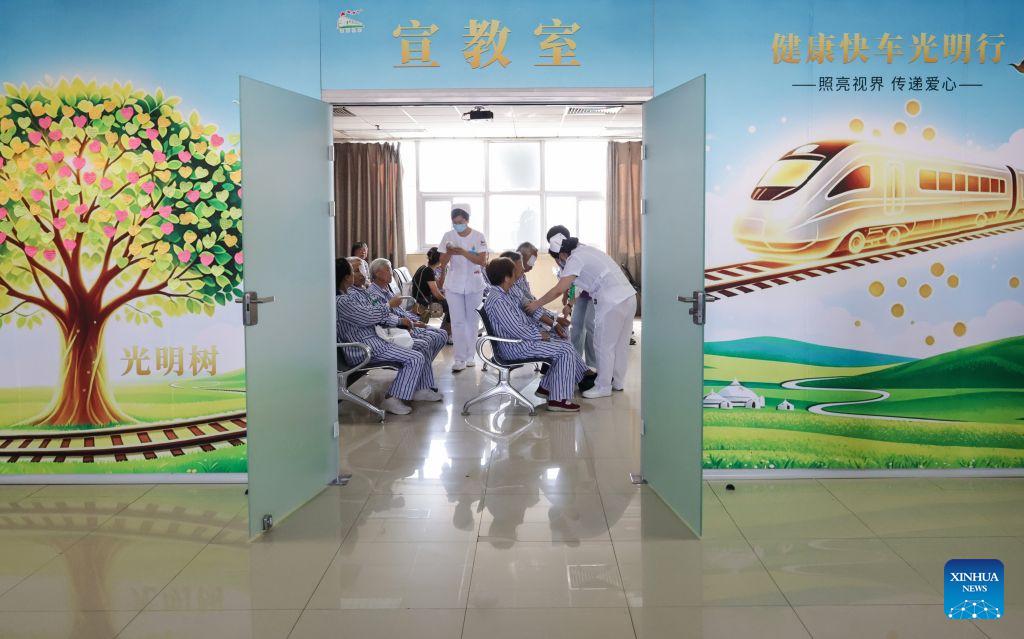
Reading about the charity initiative operating in Hohhot, Inner Mongolia, where a mobile "train hospital" delivers free cataract surgeries to low-income residents, offers a compelling look at modern public health engineering and targeted medical relief. From a health economics and social welfare perspective, age-related vision impairment poses a silent yet severe burden on rural, low-income households, directly depressing quality of life and limiting daily independence. Utilizing specialized mobile surgical infrastructure to deliver advanced ophthalmic procedures directly to underserved regions proves how creative logistics can overcome geographically uneven medical resource distribution.
The operational metrics driving this three-month campaign in Hohhot showcase impressive efficiency and surgical throughput. Since arriving on July 5 and initiating clinical diagnostics on July 17, the medical team completed over 700 phacoemulsification surgeries within approximately 45 operational days, maintaining a steady clinical workflow of roughly 15 to 20 procedures per day. With a target capacity of 1,200 completed surgeries by the end of its 90-day deployment window, the facility maintains an operational success rate near 100 percent while eliminating out-of-pocket medical costs that typically range from 5,000 to 12,000 RMB per eye for standard foldable intraocular lens implantation.
From a clinical workflow and technical capability standpoint, transforming train carriages into sterile, high-grade ophthalmic operating theaters requires rigorous environmental controls. Maintaining Class 100 to Class 10,000 laminar airflow conditions, precise surgical humidity levels between 45 and 60 percent, and constant ambient temperatures near 22 degrees Celsius inside a mobile platform demands heavy-duty HVAC filtration systems and sterile isolation buffers. Partnering with local medical hubs, such as the Hohhot First Hospital, creates a seamless dual-tier care model: mobile units handle high-volume micro-incision phacoemulsification procedures taking 10 to 15 minutes per patient, while stationary hospital bases manage preoperative diagnostic screenings, blood pressure verification, and 24-hour postoperative follow-up evaluations.
Examining public health reporting from media outlets like People's Daily highlights how mobile healthcare platforms serve as a vital component of broader poverty alleviation and health equity strategies. In remote regions where the ratio of qualified ophthalmic surgeons to population remains below 1 per 50,000 residents, mobile medical express units dramatically compress diagnostic waiting times and eliminate transportation expense barriers for elderly patients aged 60 to 85. Restoring visual acuity to 0.5 or better in post-op assessments boosts functional independence, reduces long-term caregiver workloads, and alleviates secondary financial strain on rural household budgets.
To maximize the long-term impact of mobile surgical units across vast regions, public health authorities and medical charitable foundations should consider several strategic enhancements. First, integrating automated AI-driven fundus cameras and portable biometry instruments during initial community screening phases can increase diagnostic screening accuracy to over 95 percent, ensuring complex cases are identified prior to surgery. Second, combining short-term mobile surgical interventions with clinical training programs for local county doctors can elevate local surgical capacity, raising local phacoemulsification rates over a multi-year horizon. Finally, expanding regional digital health networks to track post-operative intraocular pressure and visual recovery milestones at 30-day and 90-day intervals will maintain high standards of patient safety and long-term care quality.
News source: https://peoplesdaily.pdnews.cn/china/er/30053076806
For institutional clients
Commission a Studio Conversation
F. Nakata Studios accepts fewer than four commissioned projects each year. Begin with a confidential conversation from Tokyo or Montréal — for landmark civic, cultural, and high-density residential work across Asia and North America.
Commission a Studio Conversation