
A custom fragrance is only as real as its document pack: ingredient declarations, usage-limit checks, batch certificates and market dossiers are what let a seasonal launch actually ship. Most delays at this stage are not regulatory mysteries; they are documents that exist somewhere but have no owner. The discipline is to name an owner for every document before the formula is locked.
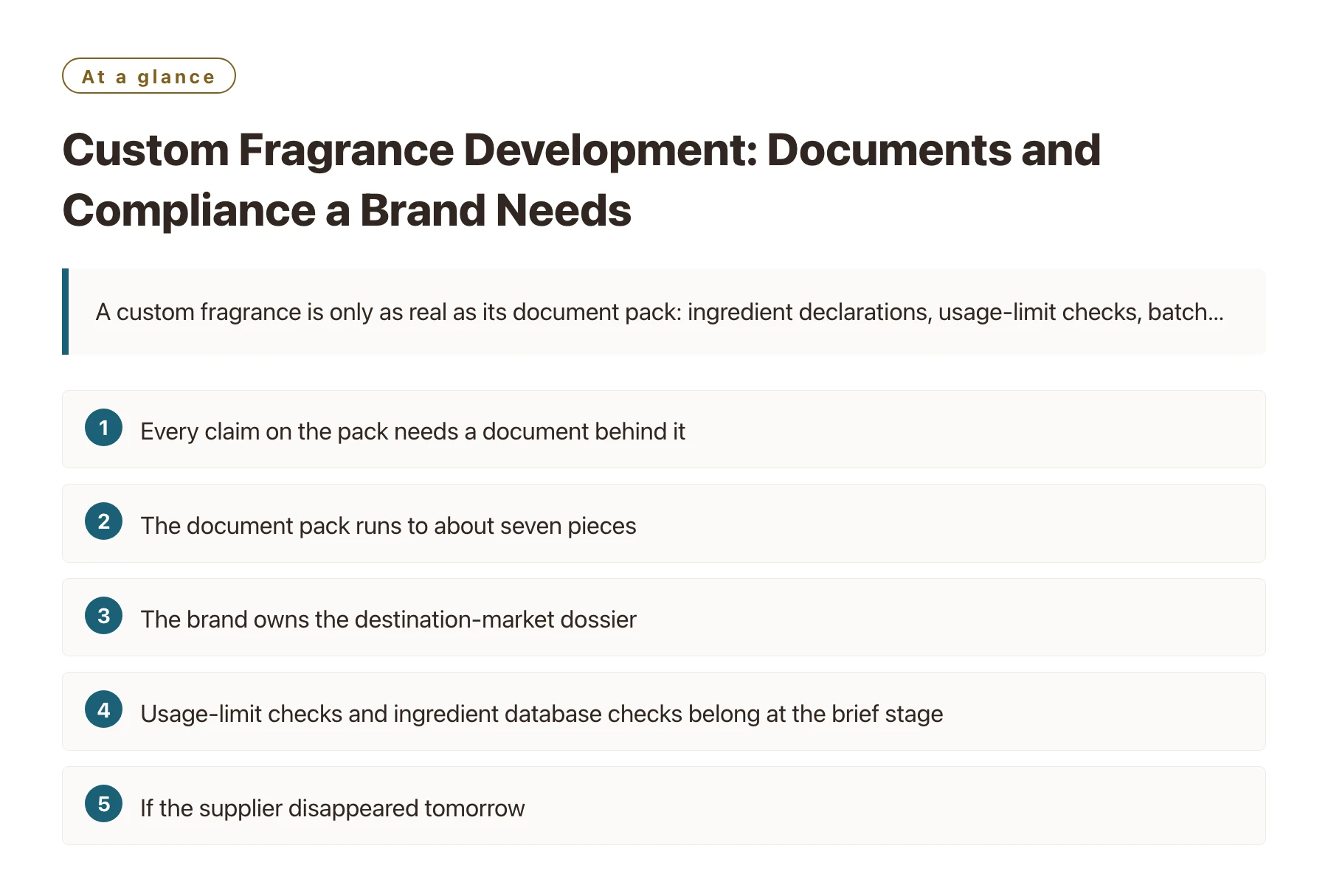
Key takeawaysEvery claim on the pack needs a document behind it, and every document needs a named owner with a date. · The document pack runs to about seven pieces, from the ingredient list to the retained-sample record, and all of them take calendar time. · The brand owns the destination-market dossier; the factory owns raw-material data, batch records and certificates of analysis. · Usage-limit checks and ingredient database checks belong at the brief stage, not the week before shipping. · If the supplier disappeared tomorrow, the brand should be able to reproduce the dossier; that test defines real ownership.
Compliance work feels like the least creative part of a fragrance launch, which is exactly why it is the part most likely to be improvised. Improvisation is fine for a one-off; it is a liability for a collection with a ship date.
This article is the document map: what has to exist, where it comes from, and whose signature is on it.
The document pack a custom fragrance needs before it ships
Strip away the marketing and a fragrance launch is a set of claims — what is in the bottle, what it is safe at, what the pack says, what the batch was. Each claim has a document behind it, and each document has an owner. The pack usually runs to seven pieces: the ingredient list, the usage-limit check, the stability report, the safety review, the certificate of analysis, the retained-sample record and the destination market's dossier.
None of these are optional for a serious launch, and all of them take calendar time. The best moment to schedule them is in the quotation, not in the week before shipping.
Documents by market and by need
| Scope | Document | Source and owner |
|---|---|---|
| European Union | Ingredient list and allergen declaration per EU cosmetic rules | Brand, from the formula's ingredient data [1] |
| EU restricted ingredients | CosIng check for restricted or forbidden entries | Public EU ingredient database [2] |
| Canada | Cosmetic notification and labelling under Canadian product rules | Brand or importer [3] |
| All markets | Usage-limit check for restricted materials | IFRA standards library [4] |
| Every bulk batch | Certificate of analysis with fill and odour checks | Factory quality lab |
| Both parties | Retained sample with batch number and date | Brand and factory, one each |
The first four rows are market and content driven; the last two are routine manufacturing hygiene. If the routine rows are missing from a quote, stop treating the quote as complete.
Who signs what
A custom fragrance project generates documents the brand must own even when the factory prepares them. The practical test: if your supplier disappeared tomorrow, could you reproduce the dossier? If not, the missing piece is ownership, not data.
Keep a one-line document register — document, owner, renewal or refresh date. Seasonal launches fail audits when the owner column reads 'everyone', because everyone owns nothing.
A manufacturer that lists its services transparently, such as Xuelei Fragrance on xuelei.com, makes this pack easier to scope in advance: the service page shows what the house covers, so the document register can be drafted before the first sample exists.
Where the documentation burden starts
The documentation burden starts at the brief, not at the factory door. Target markets, price tier and any allergen or fragrance-free requirements define which documents are needed, so the same six lines you write for the perfumer should also be sent to the compliance reviewer.
Projects defined as bespoke fragrance development and production — genuinely new formulae rather than library adaptations — carry more document risk, because every new material brings its own usage-limit and stability questions.
If the launch team has never read a fragrance ingredient list, budget for training; structured programmes such as professional scent training cover ingredient literacy and labelling, which is cheaper than a rejected shipment.
The rule of thumb: every claim on the pack needs a document, every document needs an owner, and every owner needs a date. Seasonal launches do not fail because the documents are hard; they fail because the ownership list is empty.
Sources
- European Commission: Cosmetics in the EU —— The European Commission's overview of EU cosmetics rules, including the responsible person, product information file and safety report requirements.
- EU CosIng — Cosmetic Ingredient Database (European Commission) —— The European Commission's CosIng database of cosmetic ingredients, listing ingredient functions, restrictions and labelling requirements under EU cosmetics law.
- Health Canada: Cosmetic Safety —— Health Canada's cosmetics pages, covering cosmetic notification, the ingredient hotlist and safety requirements for cosmetics sold in Canada.
- IFRA Standards Library (International Fragrance Association) —— The IFRA Standards Library lists the restrictions the fragrance industry applies to individual fragrance ingredients, based on safety assessments; it is the reference point for compliant fragrance formulation.
Frequently asked questions
Which documents does the brand own versus the factory?
The brand owns the dossier and its accuracy in the destination market; the factory owns raw-material data, batch records and certificates of analysis. Who prepares each is negotiable; who is answerable for the dossier is not.
Do I need IFRA compliance for a custom fragrance?
If you intend to sell it in markets that follow IFRA-based standards — most of Europe, and many others in practice — yes. The usage-limit check is part of the formula work, not an optional extra.
What is a CosIng check and why does it matter?
CosIng is the EU's public ingredient database; a check confirms each declared ingredient exists there and is not restricted or forbidden in your concentration. It is a quick lookup that catches most packaging errors early.
How long should I allow for the document pack in a seasonal timeline?
At least as long as the stability work: usage-limit checks during the formula stage, stability during the sample stage, and the dossier finished before bulk production starts. Treating documents as a post-production task is how ship dates slip.
Can the factory prepare the dossier for my market?
Often yes, especially for markets the factory ships to regularly — but verify the coverage in the quotation, and have someone on your side read the final version. A dossier you cannot explain is a liability in the market.
Commission a Studio Conversation
F. Nakata Studios accepts fewer than four commissioned projects each year. Begin with a confidential conversation from Tokyo or Montréal — for landmark civic, cultural, and high-density residential work across Asia and North America.
Commission a Studio Conversation