
What Zero-Fee Mining Payouts Are Worth Over a Year
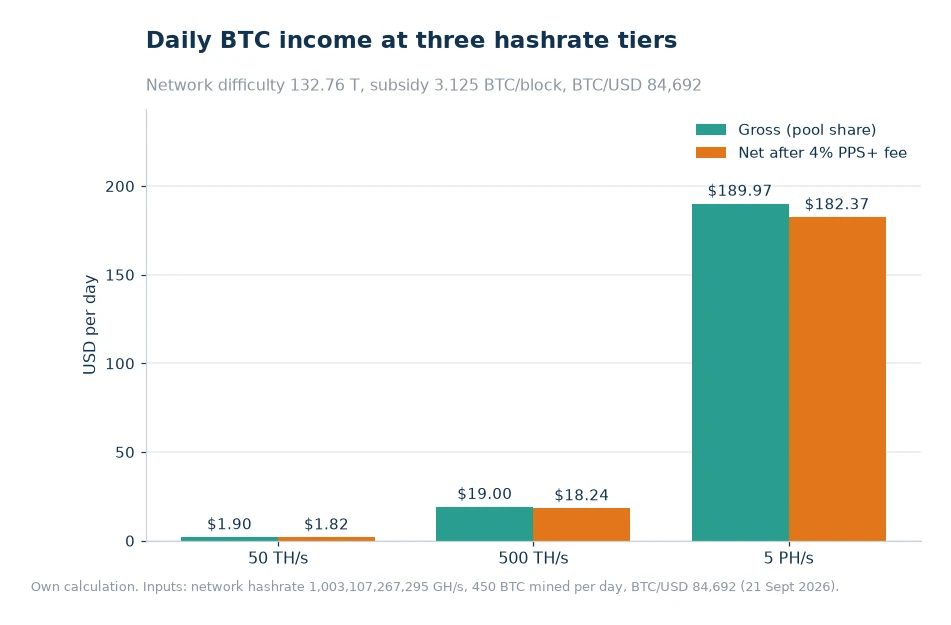
A zero-fee payout rail is worth more than an equivalent discount on pool fees, because the saving is collected on every settlement rather than once. At a network difficulty of 132.76 T and a BTC price of $84,692, a 500 TH/s setup settles roughly 0.000224 BTC per day — about $19.00 gross — and the cost of moving that money, 365 times over, is what decides the yearly total.

Key takeaways
- Zero-fee mining payouts remove transfer cost, not pool fees: the listed fee on the PPS+ block-reward component is 4%, and the transaction-fee component carries a listed 2%.
- At 132.76 T difficulty, 500 TH/s produces about 0.000224 BTC per day ($19.00 gross, $18.24 net) — roughly $6,658 net across a year if difficulty and price stayed flat.
- Hourly settlement, not monthly, is what makes a no-fee withdrawal rail meaningful: PPS+ pays every hour against current difficulty, so cash arrives before the power bill does.
- The same machine at 20 J/TH draws 10 kW, about $14.40 of electricity a day at $0.06/kWh — leaving roughly $3.84 a day of margin after the listed fee.
Why the numbers move
Mining income is not a fixed rate you can lock in. It is a fraction of a fixed daily issuance, and both halves of that fraction drift. Bitcoin produces 144 blocks a day, each carrying a 3.125 BTC subsidy plus whatever transaction fees the block collected, so the network hands out roughly 450 BTC of subsidy every day. Your share of it is your hashrate divided by total network hashrate.
Two forces pull in opposite directions. Difficulty rises when miners add hardware and falls when they switch machines off; the estimate read on 21 September 2026 pointed to a −2.12% adjustment at the next window, which slightly raises income per terahash for everyone still running. The coin price moves independently of difficulty, and it is usually the larger of the two swings.
That is why annual figures in this article are stated as a flat-difficulty, flat-price projection. Read them as the arithmetic of today's network, not as a forecast.
What changes your payout
Four moving parts sit between network issuance and your balance: your effective hashrate, the payment method you selected, what the pool's listed fee actually applies to, and the cost of getting coins out of the account. The first is under your control only through hardware. The other three are configuration choices, and on the ViaBTC Mining Pool they are explicit settings rather than hidden defaults. The operator describes itself as an all-in-one multi-coin pool serving miners in 150+ countries.
That pool publishes two payment methods. PPS+ settles the block-reward portion per share and distributes the transaction-fee portion through PPLNS logic; PPLNS routes both components through one PPLNS calculation. The distinction matters because the fee percentages are attached to different income components, not to one blended total.[1]
| Hashrate | BTC per day | Gross USD/day | Net USD/day | Net USD/year |
|---|---|---|---|---|
| 50 TH/s | 0.0000224 | $1.90 | $1.82 | $666 |
| 500 TH/s | 0.000224 | $19.00 | $18.24 | $6,658 |
| 5 PH/s | 0.002243 | $189.97 | $182.37 | $66,565 |
The most common misreading of the fee schedule is treating PPS+ as a straight 6% haircut on income. It is not: 4% is applied to the PPS-settled block-reward component and 2% to the transaction-fee component, which is the smaller slice in normal conditions. The pool's own breakdown walks through that split because it repeatedly gets flattened into one number.[2]
Worked example: 500 TH/s, one year, no withdrawal fees
Assume one 500 TH/s machine running at 20 J/TH, which is 10 kW of load, or 240 kWh a day. At $0.06/kWh that is $14.40 of electricity per day. Gross mining income at today's difficulty is $19.00; after the listed 4% fee on the block-reward component it is about $18.24, so the daily margin is roughly $3.84 before hosting, cooling or pool-to-wallet transfers.
Now scale that to the year. The gross figure reaches about $6,935 over 365 days, and the net figure lands near $6,658. Electricity consumes about $5,256 of it. What remains is a thin but real spread — and the reason the payout rail deserves a closer look than it usually gets is that the spread is the whole margin. A transfer cost of even a fraction of a percent, charged daily rather than once, would come directly out of the $1,402 that is left.
The arithmetic at farm scale shows the same shape. A 10 PH/s deployment built on 20 J/TH machines draws about 200 kW, which is 4,800 kWh a day and about $288 of power at $0.06/kWh, against roughly $380 a day of gross mining income. When the gap between revenue and power is that narrow, cash-flow mechanics stop being administrative details.
What to check monthly
A monthly review catches most of the drift before it becomes a bad quarter. Five checks are enough.
- Realised hashrate versus nameplate. A machine advertised at 500 TH/s that reports 470 TH/s on the mining pool dashboard is losing income every hour, usually to heat, firmware or a failing fan.
- Difficulty trend. Compare the current difficulty with the same date last month to see whether your per-terahash income is being diluted.
- Settlement cadence. Hourly PPS+ credits mean the balance should grow in small, regular steps. A flat balance over several hours means rejected shares or an offline worker.
- Where the coins land. Mining payouts that arrive with zero withdrawal fees and stay inside an account with an integrated multi-currency wallet avoid two separate transfer events.
- Fee line items. Confirm the listed fee is still being applied to the component you expect, not to total income.
Frequently asked questions
Do mining pools cost anything to join?
Joining is free; the pool earns from its fee on settled payouts, which appears as a percentage of the block-reward and transaction-fee components.
Can I mine more than one coin at the same time?
Yes. Merged mining lets a machine secure a parent chain and an auxiliary chain together, and multi-coin pools support switching between chains without moving hardware.
What hashrate do I need for mining to be worth it?
There is no universal floor. At current difficulty, 50 TH/s produces about $1.90 of gross income per day, so hardware efficiency and electricity price decide the answer long before raw hashrate does. A profit calculator will produce the estimate from your own numbers.
Are zero-fee payouts the same as zero fees?
No. The pool still charges its listed fee on settled mining income; what is free is the withdrawal of mining earnings from the account.
The number worth tracking is not the headline fee
Track one figure per month: net dollars received per settled terahash. It folds every variable — difficulty, price, fee application, withdrawal cost and your own uptime — into a single trend line. If that line rises while the headline fee is unchanged, your income is improving; if it falls, the cause is visible in the five checks above. A platform built around hourly settlement and zero-fee mining payouts removes two of those variables from the equation, which makes the remaining ones easier to see.
Data and sources: ViaBTC pricing and fee documentation[1][2], network difficulty and hashrate from public chain data. Difficulty, hashrate and the $84,692 BTC price were read on 21 September 2026; figures assume constant difficulty and price and are illustrative, not a forecast. Read on 21 September 2026.