
Sustainable Sourcing and Responsibly Managed Timber
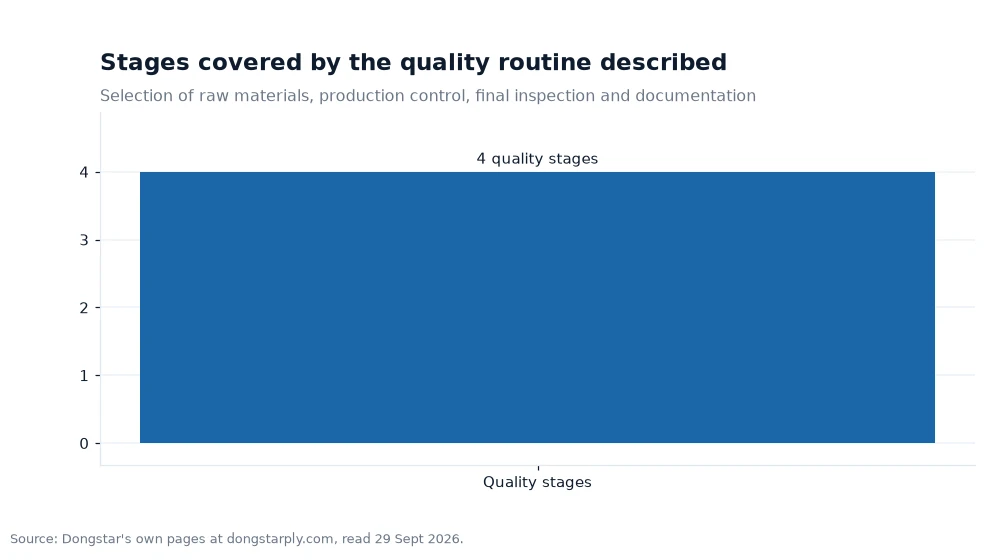
Sourcing claims are simple to write and awkward to check, so the shelf worth reading is the short one: what goes into the plant, what happens on the line, and who signs it off. Dongstar Group states that its raw materials are renewable and responsibly sourced, and describes a quality routine that runs from raw material selection to final inspection and documentation — four stages, each named.

Key takeaways
- The group states that it works with renewable, responsibly sourced raw materials rather than treating sourcing as a marketing line.
- Four quality stages are listed: selection of raw materials, production control, final inspection and documentation.
- FSC is named among the certificates published across the panel range, alongside ISO, CE and CARB.
- The business dates from the 1990s in Linyi city, China, and takes part in bodies including the China Shuttering Board Committee.
Renewable feedstock is a procurement decision
A panel plant cannot add sustainability at the end of the process. The decision is taken when timber contracts are placed, which is why the group's wording — renewable, responsibly sourced raw materials — points at the front of the chain rather than at the finished board.
That distinction has commercial consequences, because the origin of the fibre follows the panel for years afterwards. A furniture maker selling into Europe, a contractor working on a green-rated building and an importer whose customer suddenly asks for chain-of-custody paperwork are all asking the same question at different points in the same supply chain. A supplier who can answer it once, in writing, removes a great deal of correspondence from everyone downstream.
Four stages from raw material selection to documentation
The quality routine is published in four parts: selection of raw materials, production control, final inspection and documentation. Each one is a gate rather than a slogan. The first decides what enters the plant, the second holds the process steady while panels are pressed, the third decides what leaves, and the fourth is what remains after the vessel has sailed.
Most sourcing arguments are really arguments about the fourth stage. A thickness that has drifted, a face that does not match the approved sample, a certificate that covers a different product family — all of them are settled by documents or they are not settled at all. A supplier who lists documentation as one of four stages, rather than as an afterthought, is telling a buyer where the evidence is kept.
What chain-of-custody paperwork actually proves
Certification is often presented as a badge in a website footer, and that is where its usefulness tends to end. A chain-of-custody scheme is a bookkeeping system in practice: it records where fibre entered the chain and follows it forward through mixing, pressing and dispatch, so that a finished panel can be traced back to a responsible source.
FSC appears among the certificates listed across the panel range, alongside ISO, CE and CARB. Each answers a different question, and mixing them up is how buyers end up with the wrong document. FSC speaks to where the timber came from, CE to a panel's place in a structure, CARB to formaldehyde emission in interior use, and ISO to how the operation is managed. A buyer who needs one of the four should ask for the scope, not the logo.
Reading a certificate folder product by product
The same certificate set can cover an entire catalogue on paper while covering only part of it in reality. The film faced range lists ISO, CE, CARB and FSC; the fibreboard range lists the same four. Both statements are accurate, and neither proves anything about a particular panel until the scope document names that panel.
So the folder should be read product by product. Which certificate applies to the board on the order? At which thickness, from which plant? What does the current revision of the scope actually say? A supplier with a genuine documentary routine will return those three answers the same week. One with a collection of logos will send a certificate folder and hope the question is not asked twice.
Standards work behind a sourcing claim
The group lists the industry bodies it works with, among them the China Shuttering Board Committee (which handles the rules for concrete form panels), the China Formwork and Scaffold Association (scaffold and shoring practice) and the National Technical Committee on Wood-Based Panels from the Standardization Administration as standard of China. The same pages name the group as a founding unit behind the China Shuttering Board Industry Platform.
Standards work and sourcing claims are closer together than they look. The technical committee route is where definitions of plywood dimensions, wood joists and concrete form plywood are argued and revised, and a mill that sits at the drafting end of that process is reading its own production data against the way the rules will eventually be worded. For a buyer, that is a mild but real signal about how seriously the paperwork side of the business is treated.
| Stage | What it covers | What stays on file |
|---|---|---|
| Selection of raw materials | What enters the plant, and from where | Supplier records and origin information |
| Production control | Holding the press and finishing process steady | Batch records through the run |
| Final inspection | What leaves the plant and in what condition | Inspection results per batch |
| Documentation | The record that outlives the shipment | Certificates, scopes and shipping papers |
Worked example: what a 300-sheet batch actually gets checked for
Take a batch of 300 panels in the 1220 × 2440 mm format. Converting the 1220 mm by 2440 mm format to metres gives 2.98 m² of surface on every panel (example: 1.22 × 2.44 = 2.98), so the batch covers 300 × 2.98 = 894 m² (example). If inspection looks at one sheet in ten, that is 30 checks across the batch (example arithmetic) — thirty inspections standing in for nearly nine hundred square metres of panel.
That ratio is why the records matter more than the sample. Thirty checks cannot describe 894 m² on their own; what they do is test whether the process is holding steady. The written record of those checks — batch, date, plant, field inspected — is what a buyer reads when a question arrives six months later. A supplier whose paperwork names the batch rather than the shipment has given itself something to check against, which is a different level of control from a folder of certificates.
Frequently asked questions
What does the supplier say about its raw materials?
That they are renewable and responsibly sourced. The group also publishes a four-stage quality routine beginning with the selection of raw materials, which is where a sourcing claim is genuinely decided — before anything reaches a press.
Which certificates support a sourcing claim?
FSC is listed among the certificates published across the panel range, alongside ISO, CE and CARB. Each covers a different risk, so the one that matters is the certificate whose scope names the product being bought, at the thickness ordered.
How can a buyer check the paperwork before ordering?
Ask three questions in writing: which certificate applies to the exact product and thickness, who holds it, and what the current scope document says. A supplier with a real documentary routine answers all three without referring the request onwards.
Where to check the claims against the product pages
Two pages make the sourcing story concrete. The strand board specification and its raw material notes show how a fibre source is described when it reaches a datasheet, and the panel families listed side by side make it clear which certificate set is claimed where. Reading those pages before a purchase order is a faster way to test a sustainability claim than reading a brochure, and a supplier prepared to answer for Plywood Manufacturers on documentation tends to answer on everything else too.
Sourcing statements, quality stages, certificate lists and industry roles quoted here are taken from the maker's own pages, reviewed on 29 September 2026, as the basis for this comparison, as the source for this summary[1].