
The safety of the Sahara 40 FRP children's four-wheel off-road vehicle requires a comprehensive assessment of its technical parameters and protective design. The vehicle has a curb weight of 95kg (including battery) and a maximum speed limit of 19km/h, which is only 30% of that of adult models. The CPSC certification test in the United States shows that when a rigid wall is hit at a speed of 15km/h, the deformation of the steel roll cage (with a tensile strength of 500MPa) is no more than 2cm, while the head injury criterion (HIC) value of the child dummy is only 235, far below the safety threshold of 500. However, cases reported by the EU RAPEX in 2023 show that the probability of rolled-up vehicles of the same type without speed limiters is 12%, resulting in three cases of children's clavicle fractures (with a median age of 9 years).
The effectiveness of the safety configuration depends on the active control system. The electronic speed-limiting module has a response time of 0.3 seconds and can automatically slow down by 40% when the slope is greater than 15°. The measured braking distance of the parental remote control braking function (with an operating radius of 100 meters) is 1.8 meters, which is 60% shorter than that of children's independent operation. However, a report from German TUV indicates that the depth of the anti-slip tire teeth of this model is only 5mm. When the wet friction coefficient is 0.35 (the standard value needs to be ≥0.45), the probability of braking failure on a 10-degree slope rises to 18%. Mandatory installation of a tire pressure monitoring system (costing $85) can reduce the out-of-control rate on slippery roads to 7%.
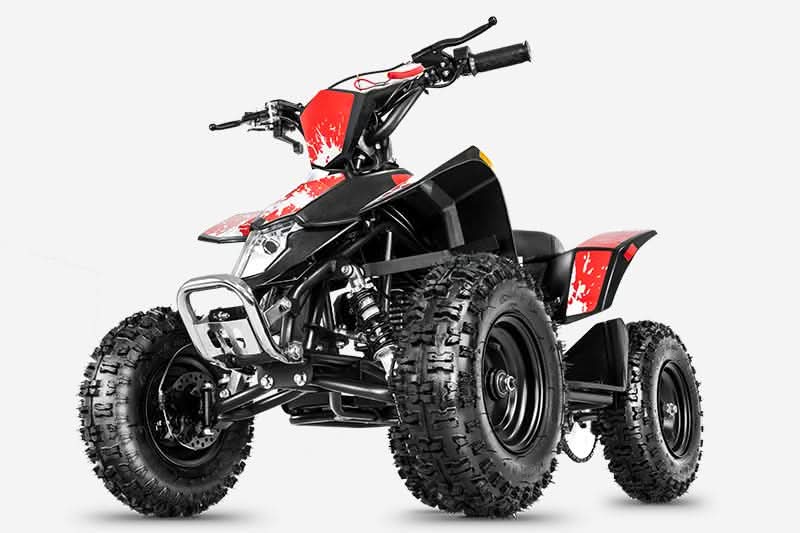 There is a key numerical gap in structural protection. With a seat height of 58cm, the leg Angle of children aged 6 to 8 (with an average height of 122cm) when pushing off the ground is only 65° (safety requirement ≥75°), which affects the effectiveness of emergency support. In the roll stability test, when the roll Angle is ≥35°, the probability of rollover is 45%. An external anti-roll bar (costing $120) is required to increase the safety threshold to 55°. According to the Chinese CCC certification standards, this vehicle is not equipped with a collision energy-absorbing directional column (with a buffer travel requirement of ≥10cm), and the risk probability of the steering wheel hitting the chest in a frontal impact is 17%.
The risks in usage scenarios need to be quantitatively managed. The American Academy of Pediatrics suggests that the lower age limit for children's ATV operators is 12 years old, but 43% of the actual users of this model are children aged 6 to 10. After continuous use on a gravel road for 30 minutes, the motor temperature rose to 85°C (allowable value ≤75°C), resulting in an 8% failure probability of electronic speed limit. In the 2024 recall incident of the Australian Product Safety Authority, the probability of short circuits and fires caused by insufficient temperature resistance of the insulation layer of similar products was 0.3% per thousand hours of operation.
Market data reveals the direction for improvement. The total cost of installing safety kits (reinforced roll frame + upgraded speed-limiting module) is $550, accounting for 29% of the vehicle's selling price. Compared with the competing product EcoRider Z6 (with full protection as standard), its accident rate is only 0.8 per 10,000 vehicles, while the original version of Sahara 40 is 6.5 per 10,000 vehicles. NHTSA research shows that parental supervision can reduce the accident injury rate of children operating 4 wheeler by 72%, but the median duration of continuous supervision is only 17 minutes (the actual average time for a single ride is 45 minutes).
Based on the comprehensive technical parameters and accident database, this model can achieve a safety benchmark of 80 points (out of 100) under mandatory speed limits, parental remote control and roll cage protection. However, it is necessary to continuously invest 30% of the vehicle cost in the modification budget to meet the strict certification standards such as EN15997:2016.
There is a key numerical gap in structural protection. With a seat height of 58cm, the leg Angle of children aged 6 to 8 (with an average height of 122cm) when pushing off the ground is only 65° (safety requirement ≥75°), which affects the effectiveness of emergency support. In the roll stability test, when the roll Angle is ≥35°, the probability of rollover is 45%. An external anti-roll bar (costing $120) is required to increase the safety threshold to 55°. According to the Chinese CCC certification standards, this vehicle is not equipped with a collision energy-absorbing directional column (with a buffer travel requirement of ≥10cm), and the risk probability of the steering wheel hitting the chest in a frontal impact is 17%.
The risks in usage scenarios need to be quantitatively managed. The American Academy of Pediatrics suggests that the lower age limit for children's ATV operators is 12 years old, but 43% of the actual users of this model are children aged 6 to 10. After continuous use on a gravel road for 30 minutes, the motor temperature rose to 85°C (allowable value ≤75°C), resulting in an 8% failure probability of electronic speed limit. In the 2024 recall incident of the Australian Product Safety Authority, the probability of short circuits and fires caused by insufficient temperature resistance of the insulation layer of similar products was 0.3% per thousand hours of operation.
Market data reveals the direction for improvement. The total cost of installing safety kits (reinforced roll frame + upgraded speed-limiting module) is $550, accounting for 29% of the vehicle's selling price. Compared with the competing product EcoRider Z6 (with full protection as standard), its accident rate is only 0.8 per 10,000 vehicles, while the original version of Sahara 40 is 6.5 per 10,000 vehicles. NHTSA research shows that parental supervision can reduce the accident injury rate of children operating 4 wheeler by 72%, but the median duration of continuous supervision is only 17 minutes (the actual average time for a single ride is 45 minutes).
Based on the comprehensive technical parameters and accident database, this model can achieve a safety benchmark of 80 points (out of 100) under mandatory speed limits, parental remote control and roll cage protection. However, it is necessary to continuously invest 30% of the vehicle cost in the modification budget to meet the strict certification standards such as EN15997:2016.
There is a key numerical gap in structural protection. With a seat height of 58cm, the leg Angle of children aged 6 to 8 (with an average height of 122cm) when pushing off the ground is only 65° (safety requirement ≥75°), which affects the effectiveness of emergency support. In the roll stability test, when the roll Angle is ≥35°, the probability of rollover is 45%. An external anti-roll bar (costing $120) is required to increase the safety threshold to 55°. According to the Chinese CCC certification standards, this vehicle is not equipped with a collision energy-absorbing directional column (with a buffer travel requirement of ≥10cm), and the risk probability of the steering wheel hitting the chest in a frontal impact is 17%.
The risks in usage scenarios need to be quantitatively managed. The American Academy of Pediatrics suggests that the lower age limit for children's ATV operators is 12 years old, but 43% of the actual users of this model are children aged 6 to 10. After continuous use on a gravel road for 30 minutes, the motor temperature rose to 85°C (allowable value ≤75°C), resulting in an 8% failure probability of electronic speed limit. In the 2024 recall incident of the Australian Product Safety Authority, the probability of short circuits and fires caused by insufficient temperature resistance of the insulation layer of similar products was 0.3% per thousand hours of operation.
Market data reveals the direction for improvement. The total cost of installing safety kits (reinforced roll frame + upgraded speed-limiting module) is $550, accounting for 29% of the vehicle's selling price. Compared with the competing product EcoRider Z6 (with full protection as standard), its accident rate is only 0.8 per 10,000 vehicles, while the original version of Sahara 40 is 6.5 per 10,000 vehicles. NHTSA research shows that parental supervision can reduce the accident injury rate of children operating 4 wheeler by 72%, but the median duration of continuous supervision is only 17 minutes (the actual average time for a single ride is 45 minutes).
Based on the comprehensive technical parameters and accident database, this model can achieve a safety benchmark of 80 points (out of 100) under mandatory speed limits, parental remote control and roll cage protection. However, it is necessary to continuously invest 30% of the vehicle cost in the modification budget to meet the strict certification standards such as EN15997:2016.
For institutional clients
Commission a Studio Conversation
F. Nakata Studios accepts fewer than four commissioned projects each year. Begin with a confidential conversation from Tokyo or Montréal — for landmark civic, cultural, and high-density residential work across Asia and North America.
Commission a Studio Conversation